De Beers Blood Diamonds Policy and Verification Standards Traced in New Industry Report
Analysis reviews the certification schemes De Beers has used to address blood diamonds, published ahead of 2026 reviews of international rough-diamond trade standards.
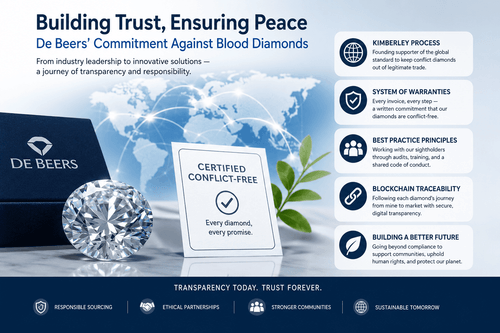
A newly compiled industry analysis released this week traces the history of De Beers blood diamonds policy, examining how the company has developed and applied certification and verification frameworks over the past two decades to address the trade in conflict diamonds, commonly known as blood diamonds. The report was compiled ahead of upcoming reviews of international rough-diamond trade standards and comes as retailers, buyers, and regulators continue to examine supply-chain transparency across the jewelry industry.
Conflict diamonds are diamonds mined in war zones and sold to help finance armed conflict against recognized governments, a practice that drew international attention during civil wars in parts of West and Central Africa during the 1990s. In response, the diamond industry, together with participating governments and non-governmental organizations, established the Kimberley Process Certification Scheme (KPCS) in 2003. The KPCS is an international system that requires rough diamonds to be certified as conflict-free before they can be legally exported or imported between participating countries.
According to the analysis, any review of De Beers blood diamonds policy typically starts with the Kimberley Process, since De Beers was among the founding supporters of the KPCS. The company has since added further internal measures on top of that government-run certification system. These include its System of Warranties, which requires every diamond invoice moving through the supply chain — from rough stone to polished jewelry — to carry a written statement affirming the diamonds are conflict-free. De Beers has also put in place its own Best Practice Principles, an internal code of conduct requiring approved buyers, known as sightholders, to warrant compliance and to submit to periodic audits.
More recently, the report notes, De Beers has invested in blockchain-based tracking technology designed to follow individual diamonds from the point of mining through cutting, polishing, and retail sale. Industry observers say this type of traceability tool addresses a longstanding gap in the Kimberley Process, under which government certification travels with rough stones but becomes harder to verify once diamonds are cut, polished, and blended with stones from other sources.
The analysis also outlines limitations in the framework currently used to address De Beers blood diamonds and the wider industry supply chain. Because the Kimberley Process defines a conflict diamond narrowly, as one used to fund rebel movements against recognized governments, it does not address other supply-chain concerns such as labor conditions or state-linked violence that fall outside that definition. Several non-governmental organizations have previously called for certification schemes to be broadened in scope.
"Supply-chain verification in the diamond industry has evolved considerably since the early 2000s, but it remains a layered system involving government certification, company-level warranties, and increasingly, digital tracking tools," the report states, noting that no single mechanism currently covers every stage of the supply chain on its own.
The report is intended to inform ongoing discussions among industry stakeholders, retailers, and policymakers evaluating how certification and verification standards may need to adapt as sourcing expectations continue to shift. Diamond producers, retailers, and industry bodies are expected to continue reviewing certification frameworks over the coming year, with the topic of De Beers blood diamonds policy likely to remain part of that broader conversation.
About the Report : The analysis was independently compiled from publicly available industry and governmental sources on diamond supply-chain certification. It does not constitute an endorsement of any single company's practices and is intended for informational and industry-reference purposes.
Media Contact
Contact person: Juam
Company: Press Hub